
Most of what we know about women in early India was made by hand. This site reads the objects they left — cloth, clay, stone, copper — and says only what those objects can carry.
The Northeast, first
The site opens here rather than at the earliest date. The northeastern valleys are the least excavated and most often left out of the standard chronology, and the evidence that does survive there is unusually good on work: lake labour, loom, and rite.
Starting here is a choice about what gets looked at first. It is not a claim that it came first, and nothing on these pages argues priority. The chronology restarts at 1500 BCE directly below, and every band in it is dated on its own terms.
The rule is the same across the whole site: show the material, state what it carries, and stop. Where a reading comes from living practice rather than excavation it is tagged by continuity and treated as the weakest of the three.

The chronology, 1500 BCE onward
Every dynasty the site intends to cover has a slot here from day one, so the shape of the argument is visible before the work is done. Slots marked in progress are placed and dated but not yet written.
The same plates, read by what she is doing
Dress changes by century and by region. The work changes far less. Filter every plate on the site by the role it shows, and the continuities across a thousand years become the easier thing to see.
Roles are tags on plates, not pages of their own. A plate can carry more than one. Only roles the shipped plates actually carry are listed here; the full set of sixteen is in the intake vocabulary.








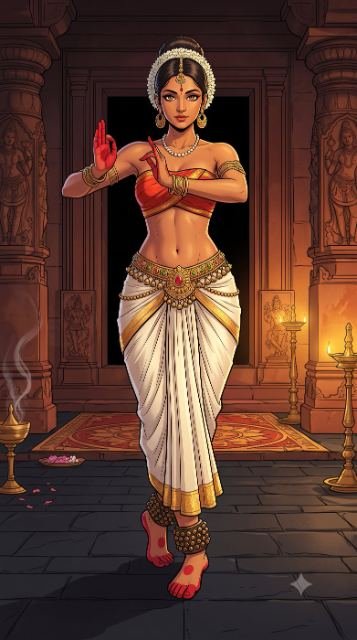
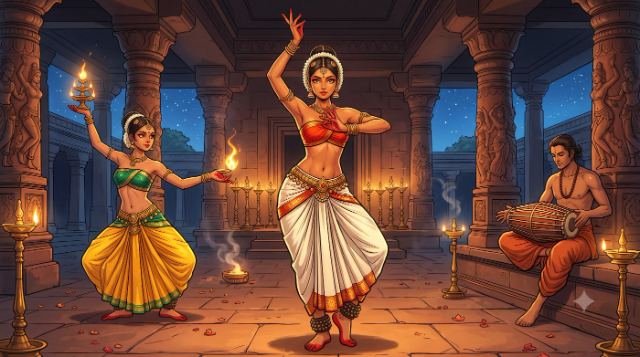


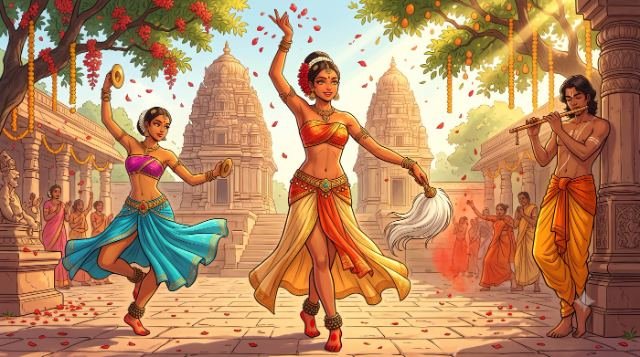
21 plates across 4 written eras. The count rises as slots fill.
Writing
Longer readings that a plate caption cannot hold: essays on a period, notes on a single contested line, and spec sheets that take one garment apart term by term.
Lopāmudrā, Ghoṣā, Mudgalānī, Romaśā, Viśpalā — what the hymns attribute to each, and where the attribution is contested.
Cut-and-sewn clothing meets the wrapped system, and both appear on the same reliefs at Mathura.
A body of verse that describes work rather than only ornament, and the named women who composed it.
The first administrative text that names women as workers and assigns them wages, read against what the sculpture shows.
Beyond the subcontinent
Indic forms travelled, and were remade wherever they landed. This arm covers that — as its own structure, not as an appendix to the dated bands. Nothing here is built yet; the slots are placed so the scope is honest about where it is going.
These are separate societies with their own chronologies. Putting them on one date spine with the subcontinent would suggest a relationship the evidence does not carry, so they sit apart.
Method
One rule, applied the same way in every period, including the ones that get argued about.
The object itself carries it. An inscription that names a woman donor, a tool found in a house floor, a garment shown on a dated relief.
Reasoned from comparable material of the same period and region. The reasoning is stated on the plate so it can be disagreed with.
Living practice read backwards. The weakest of the three, used where nothing else survives, and never presented as excavated.
The site does not assign cause. It says what an object shows and where the showing stops. Where periods are argued over politically, the same rule applies without exception: no claim here runs ahead of the material it rests on, in either direction.
Every plate carries a numbered footnote to its source, and each era page ends with the works its readings are built from. Collection or museum is named on each plate where the object is a real one.
Figures on this site are drawn, not photographed, and the drawings carry known errors that are being corrected rather than hidden. Declared once here instead of repeated on every plate:
- Several figures wear a seamless modern breast-band. The pratidhi was cloth strips tied at the back, with a visible knot.
- Ornament is heavier than the period warrants — zari borders and temple sets where restrained bangles and a single necklace belong.
- Where a manuscript appears in a Vedic-period frame it is an anachronism twice over: the corpus was oral, and neither rolled scrolls nor bound codices existed in India.
- Some frames carry later architecture or later devotional iconography than their caption's date. Where that is known it is said on the plate.
- Dress in the Gupta band follows a modern South Indian idiom rather than the striped and patterned cloth the Ajanta painting actually shows.
None of these affect the textual and epigraphic claims, which rest on the sources listed per era, not on the drawings.
New eras go up as the sources come in
Each open slot above is waiting on citations, not on design. When a dynasty's sources are in hand, its page is written and the slot goes live.
If a reading here is wrong, or an object is mis-credited, say so. The confidence tag on every plate exists so that disagreement has something specific to land on.